

How To Draw An Equilateral Triangle With A Compass

Creating a regular hexagon with a straightedge and compass
Straightedge and compass construction, also known every bit ruler-and-compass structure or classical construction, is the construction of lengths, angles, and other geometric figures using only an idealized ruler and a pair of compasses.
The idealized ruler, known as a straightedge, is assumed to be infinite in length, have only one edge, and no markings on it. The compass is assumed to have no maximum or minimum radius, and is assumed to "collapse" when lifted from the page, so may not be directly used to transfer distances. (This is an unimportant brake since, using a multi-step procedure, a distance can be transferred even with a collapsing compass; encounter compass equivalence theorem. Note however that whilst a non-collapsing compass held against a straightedge might seem to be equivalent to marker information technology, the neusis structure is still impermissible and this is what unmarked really means: see Markable rulers beneath.) More formally, the only permissible constructions are those granted by Euclid'southward first 3 postulates.
It turns out to be the instance that every point constructible using straightedge and compass may also be constructed using compass alone, or by straightedge alone if given a single circle and its heart.
The ancient Greek mathematicians start conceived straightedge and compass constructions, and a number of ancient issues in aeroplane geometry impose this restriction. The ancient Greeks developed many constructions, merely in some cases were unable to exercise and then. Gauss showed that some polygons are constructible just that most are not. Some of the most famous straightedge and compass issues were proved incommunicable past Pierre Wantzel in 1837, using the mathematical theory of fields.
In spite of existing proofs of impossibility, some persist in trying to solve these problems.[1] Many of these issues are easily solvable provided that other geometric transformations are allowed: for example, doubling the cube is possible using geometric constructions, merely not possible using straightedge and compass alone.
In terms of algebra, a length is constructible if and only if information technology represents a constructible number, and an bending is constructible if and only if its cosine is a constructible number. A number is constructible if and only if information technology can be written using the four basic arithmetics operations and the extraction of foursquare roots only of no college-order roots.
Straightedge and compass tools [edit]


The "straightedge" and "compass" of straightedge and compass constructions are idealizations of rulers and compasses in the existent world:
- The straightedge is infinitely long, but it has no markings on information technology and has only 1 straight edge, unlike ordinary rulers. The line drawn is infinitesimally thin point-width. It can only exist used to draw a line segment between two points, with space precision to those points, or to extend an existing segment.
- The compass can be opened arbitrarily broad, but (dissimilar some real compasses) it has no markings on it. Circles can just be drawn starting from two given points: the centre and a point on the circle, and aligned to those points with space precision. The arc that is fatigued is infinitesimally thin point-width. The compass may or may non plummet when it is not drawing a circumvolve.
Actual compasses do not collapse and modern geometric constructions often use this feature. A 'collapsing compass' would appear to be a less powerful instrument. Even so, by the compass equivalence theorem in Proposition 2 of Book 1 of Euclid's Elements, no ability is lost by using a collapsing compass. Although the proposition is correct, its proofs have a long and checkered history.[2] In whatever case, the equivalence is why this feature is not stipulated in the definition of the platonic compass.
Each construction must be verbal. "Eyeballing" it (essentially looking at the structure and guessing at its accurateness, or using some form of measurement, such as the units of measure on a ruler) and getting shut does non count as a solution.
Each construction must terminate. That is, it must have a finite number of steps, and not exist the limit of ever closer approximations.
Stated this way, straightedge and compass constructions announced to exist a parlour game, rather than a serious practical trouble; but the purpose of the restriction is to ensure that constructions tin can be proved to be exactly correct.
History [edit]
The ancient Greek mathematicians beginning attempted straightedge and compass constructions, and they discovered how to construct sums, differences, products, ratios, and square roots of given lengths.[3] : p. 1 They could also construct half of a given bending, a square whose area is twice that of another square, a square having the same area as a given polygon, and a regular polygon with 3, four, or 5 sides[3] : p. eleven (or ane with twice the number of sides of a given polygon[3] : pp. 49–50 ). But they could non construct one third of a given angle except in particular cases, or a square with the aforementioned area every bit a given circle, or a regular polygon with other numbers of sides.[3] : p. eleven Nor could they construct the side of a cube whose volume would exist twice the volume of a cube with a given side.[3] : p. 29
Hippocrates and Menaechmus showed that the volume of the cube could be doubled by finding the intersections of hyperbolas and parabolas, simply these cannot be synthetic past straightedge and compass.[3] : p. 30 In the fifth century BCE, Hippias used a curve that he called a quadratrix to both trisect the full general bending and square the circle, and Nicomedes in the second century BCE showed how to use a conchoid to trisect an capricious angle;[3] : p. 37 only these methods also cannot be followed with just straightedge and compass.
No progress on the unsolved problems was made for two millennia, until in 1796 Gauss showed that a regular polygon with 17 sides could be synthetic; five years later he showed the sufficient criterion for a regular polygon of n sides to be constructible.[3] : pp. 51 ff.
In 1837 Pierre Wantzel published a proof of the impossibility of trisecting an capricious bending or of doubling the volume of a cube,[4] based on the impossibility of amalgam cube roots of lengths. He also showed that Gauss's sufficient constructibility condition for regular polygons is also necessary.[five]
Then in 1882 Lindemann showed that is a transcendental number, and thus that it is impossible past straightedge and compass to construct a square with the same expanse as a given circle.[iii] : p. 47

The basic constructions [edit]

All straightedge and compass constructions consist of repeated awarding of five basic constructions using the points, lines and circles that accept already been constructed. These are:
- Creating the line through two existing points
- Creating the circle through one point with centre another point
- Creating the point which is the intersection of 2 existing, not-parallel lines
- Creating the one or two points in the intersection of a line and a circle (if they intersect)
- Creating the 1 or 2 points in the intersection of two circles (if they intersect).
For instance, starting with merely 2 distinct points, we can create a line or either of two circles (in turn, using each indicate every bit centre and passing through the other indicate). If we draw both circles, two new points are created at their intersections. Drawing lines between the two original points and 1 of these new points completes the construction of an equilateral triangle.
Therefore, in any geometric problem we accept an initial set of symbols (points and lines), an algorithm, and some results. From this perspective, geometry is equivalent to an axiomatic algebra, replacing its elements by symbols. Probably Gauss first realized this, and used it to show the impossibility of some constructions; only much later did Hilbert find a complete set of axioms for geometry.
Much used straightedge and compass constructions [edit]
The near-used straightedge and compass constructions include:
- Constructing the perpendicular bisector from a segment
- Finding the midpoint of a segment.
- Drawing a perpendicular line from a point to a line.
- Bisecting an angle
- Mirroring a indicate in a line
- Constructing a line through a point tangent to a circle
- Constructing a circumvolve through 3 noncollinear points
- Drawing a line through a given point parallel to a given line.
Constructible points [edit]
| Straightedge and compass constructions corresponding to algebraic operations | ||
|---|---|---|
| x=a·b (intercept theorem) | x=a/b (intercept theorem) | x=√ a (Pythagorean theorem) |


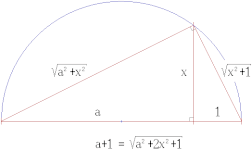
One can associate an algebra to our geometry using a Cartesian coordinate system fabricated of two lines, and stand for points of our aeroplane by vectors. Finally we can write these vectors as complex numbers.
Using the equations for lines and circles, one can show that the points at which they intersect lie in a quadratic extension of the smallest field F containing ii points on the line, the center of the circle, and the radius of the circumvolve. That is, they are of the form 10 +y √ k , where x, y, and k are in F.
Since the field of constructible points is airtight nether foursquare roots, it contains all points that tin can be obtained past a finite sequence of quadratic extensions of the field of complex numbers with rational coefficients. By the above paragraph, one can show that any constructible signal can be obtained past such a sequence of extensions. Equally a corollary of this, 1 finds that the degree of the minimal polynomial for a constructible signal (and therefore of any constructible length) is a ability of 2. In particular, any constructible point (or length) is an algebraic number, though non every algebraic number is constructible; for example, 3√ii is algebraic but not constructible.[4]
Constructible angles [edit]
There is a bijection between the angles that are constructible and the points that are constructible on any constructible circle. The angles that are constructible form an abelian grouping under addition modulo 2π (which corresponds to multiplication of the points on the unit circumvolve viewed equally circuitous numbers). The angles that are constructible are exactly those whose tangent (or equivalently, sine or cosine) is constructible equally a number. For instance, the regular heptadecagon (the seventeen-sided regular polygon) is constructible because

as discovered by Gauss.[half-dozen]
The group of constructible angles is airtight under the operation that halves angles (which corresponds to taking foursquare roots in the complex numbers). The only angles of finite order that may be synthetic starting with two points are those whose order is either a power of two, or a product of a power of two and a set of distinct Fermat primes. In improver there is a dense set of constructible angles of infinite lodge.
Relation to complex arithmetic [edit]
Given a set of points in the Euclidean plane, selecting any one of them to be called 0 and another to be called 1, together with an capricious choice of orientation allows us to consider the points as a set of circuitous numbers.
Given any such interpretation of a set of points as complex numbers, the points constructible using valid straightedge and compass constructions alone are precisely the elements of the smallest field containing the original gear up of points and closed nether the complex conjugate and square root operations (to avert ambivalence, we can specify the square root with complex argument less than π). The elements of this field are precisely those that may be expressed equally a formula in the original points using only the operations of add-on, subtraction, multiplication, sectionalisation, complex conjugate, and square root, which is hands seen to be a countable dumbo subset of the plane. Each of these six operations respective to a simple straightedge and compass construction. From such a formula it is straightforward to produce a construction of the respective point by combining the constructions for each of the arithmetic operations. More efficient constructions of a detail set of points correspond to shortcuts in such calculations.
Equivalently (and with no demand to arbitrarily choose two points) nosotros tin can say that, given an arbitrary choice of orientation, a set of points determines a set of complex ratios given by the ratios of the differences between whatsoever two pairs of points. The set of ratios constructible using straightedge and compass from such a set of ratios is precisely the smallest field containing the original ratios and airtight nether taking complex conjugates and square roots.
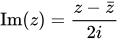
For example, the real part, imaginary function and modulus of a betoken or ratio z (taking one of the 2 viewpoints in a higher place) are constructible as these may exist expressed as


Doubling the cube and trisection of an angle (except for special angles such as whatsoever φ such that φ/2π is a rational number with denominator not divisible by 3) require ratios which are the solution to cubic equations, while squaring the circle requires a transcendental ratio. None of these are in the fields described, hence no straightedge and compass construction for these exists.
Impossible constructions [edit]
The aboriginal Greeks thought that the construction bug they could not solve were simply obstinate, non unsolvable.[7] With modern methods, however, these straightedge and compass constructions accept been shown to be logically incommunicable to perform. (The bug themselves, all the same, are solvable, and the Greeks knew how to solve them without the constraint of working but with straightedge and compass.)
Squaring the circle [edit]
The most famous of these problems, squaring the circle, otherwise known equally the quadrature of the circumvolve, involves constructing a square with the same surface area as a given circumvolve using only straightedge and compass.
Squaring the circumvolve has been proved incommunicable, equally information technology involves generating a transcendental number, that is, √ π . Only sure algebraic numbers can be constructed with ruler and compass lone, namely those constructed from the integers with a finite sequence of operations of add-on, subtraction, multiplication, sectionalization, and taking square roots. The phrase "squaring the circle" is oft used to mean "doing the impossible" for this reason.
Without the constraint of requiring solution by ruler and compass solitary, the problem is easily solvable past a broad variety of geometric and algebraic means, and was solved many times in artifact.[8]
A method which comes very close to approximating the "quadrature of the circle" can exist achieved using a Kepler triangle.
Doubling the cube [edit]
Doubling the cube is the construction, using only a straight-border and compass, of the edge of a cube that has twice the volume of a cube with a given border. This is impossible because the cube root of ii, though algebraic, cannot be computed from integers by addition, subtraction, multiplication, division, and taking square roots. This follows because its minimal polynomial over the rationals has caste 3. This construction is possible using a straightedge with two marks on information technology and a compass.
Angle trisection [edit]
Angle trisection is the construction, using merely a straightedge and a compass, of an angle that is 1-third of a given arbitrary bending. This is incommunicable in the general case. For example, the angle 2π/5 radians (72° = 360°/5) can be trisected, but the angle of π/3 radians (60°) cannot exist trisected.[9] The general trisection trouble is also easily solved when a straightedge with ii marks on it is allowed (a neusis construction).
Distance to an ellipse [edit]
The line segment from any signal in the plane to the nearest signal on a circle can be synthetic, but the segment from any indicate in the plane to the nearest indicate on an ellipse of positive eccentricity cannot in full general be constructed.[10]
Alhazen's problem [edit]
In 1997, the Oxford mathematician Peter M. Neumann proved the theorem that in that location is no ruler-and-compass structure for the general solution of the ancient Alhazen'south problem (billiard trouble or reflection from a spherical mirror).[eleven] [12]
Constructing regular polygons [edit]

Some regular polygons (eastward.g. a pentagon) are easy to construct with straightedge and compass; others are not. This led to the question: Is it possible to construct all regular polygons with straightedge and compass?
Carl Friedrich Gauss in 1796 showed that a regular 17-sided polygon can be constructed, and five years afterward showed that a regular n-sided polygon tin can be constructed with straightedge and compass if the odd prime factors of due north are singled-out Fermat primes. Gauss conjectured that this condition was besides necessary, but he offered no proof of this fact, which was provided by Pierre Wantzel in 1837.[5]
The first few constructible regular polygons have the following numbers of sides:
- 3, four, 5, 6, 8, 10, 12, 15, xvi, 17, 20, 24, 30, 32, 34, 40, 48, 51, 60, 64, 68, 80, 85, 96, 102, 120, 128, 136, 160, 170, 192, 204, 240, 255, 256, 257, 272... (sequence A003401 in the OEIS)
There are known to be an infinitude of constructible regular polygons with an even number of sides (considering if a regular n-gon is constructible, and so so is a regular iin-gon and hence a regular 4n-gon, 8n-gon, etc.). However, at that place are only 31 known constructible regular n-gons with an odd number of sides.
Constructing a triangle from iii given characteristic points or lengths [edit]
Sixteen key points of a triangle are its vertices, the midpoints of its sides, the feet of its altitudes, the feet of its internal angle bisectors, and its circumcenter, centroid, orthocenter, and incenter. These can be taken three at a fourth dimension to yield 139 distinct nontrivial problems of constructing a triangle from three points.[13] Of these issues, iii involve a signal that tin be uniquely synthetic from the other two points; 23 tin can exist non-uniquely constructed (in fact for infinitely many solutions) only only if the locations of the points obey certain constraints; in 74 the problem is constructible in the full general example; and in 39 the required triangle exists but is not constructible.
Twelve key lengths of a triangle are the three side lengths, the three altitudes, the three medians, and the 3 bending bisectors. Together with the iii angles, these requite 95 distinct combinations, 63 of which requite rising to a constructible triangle, thirty of which practice not, and two of which are underdefined.[xiv] : pp. 201–203
Restricted Constructions [edit]
Various attempts have been made to restrict the allowable tools for constructions under diverse rules, in social club to determine what is still constructable and how information technology may be synthetic, besides as determining the minimum criteria necessary to nevertheless be able to construct everything that compass and straightedge can.
Constructing with just ruler or but compass [edit]
It is possible (according to the Mohr–Mascheroni theorem) to construct anything with just a compass if it tin can be synthetic with a ruler and compass, provided that the given data and the data to be found consist of discrete points (not lines or circles). The truth of this theorem depends on the truth of Archimedes' axiom,[fifteen] which is non get-go-order in nature. Examples of compass-only constructions include Napoleon's problem.
It is impossible to take a foursquare root with but a ruler, then some things that cannot be constructed with a ruler tin can be constructed with a compass; but (past the Poncelet–Steiner theorem) given a single circle and its center, they can exist constructed.
Extended constructions [edit]
The ancient Greeks classified constructions into three major categories, depending on the complexity of the tools required for their solution. If a construction used just a straightedge and compass, it was called planar; if it likewise required i or more conic sections (other than the circumvolve), and then it was called solid; the tertiary category included all constructions that did not fall into either of the other ii categories.[16] This categorization meshes nicely with the mod algebraic signal of view. A complex number that can be expressed using only the field operations and square roots (as described above) has a planar construction. A complex number that includes also the extraction of cube roots has a solid construction.
In the language of fields, a complex number that is planar has degree a power of 2, and lies in a field extension that can be broken downwardly into a tower of fields where each extension has degree two. A circuitous number that has a solid construction has degree with prime factors of merely two and 3, and lies in a field extension that is at the superlative of a belfry of fields where each extension has caste 2 or iii.
Solid constructions [edit]
A point has a solid structure if it can exist constructed using a straightedge, compass, and a (peradventure hypothetical) conic drawing tool that can draw any conic with already constructed focus, directrix, and eccentricity. The aforementioned set of points can ofttimes be constructed using a smaller set of tools. For example, using a compass, straightedge, and a piece of newspaper on which nosotros have the parabola y=102 together with the points (0,0) and (i,0), i tin can construct whatever complex number that has a solid construction. Besides, a tool that can draw whatever ellipse with already constructed foci and major axis (think 2 pins and a piece of string) is just every bit powerful.[17]
The ancient Greeks knew that doubling the cube and trisecting an arbitrary angle both had solid constructions. Archimedes gave a solid construction of the regular seven-gon. The quadrature of the circle does not take a solid construction.
A regular north-gon has a solid construction if and just if due north=two j 3 yard m where g is a product of distinct Pierpont primes (primes of the class two r 3 s +1). The set of such n is the sequence
- seven, 9, thirteen, 14, xviii, 19, 21, 26, 27, 28, 35, 36, 37, 38, 39, 42, 45, 52, 54, 56, 57, 63, 65, lxx, 72, 73, 74, 76, 78, 81, 84, xc, 91, 95, 97... (sequence A051913 in the OEIS)
The set of due north for which a regular n-gon has no solid construction is the sequence
- 11, 22, 23, 25, 29, 31, 33, 41, 43, 44, 46, 47, 49, l, 53, 55, 58, 59, 61, 62, 66, 67, 69, 71, 75, 77, 79, 82, 83, 86, 87, 88, 89, 92, 93, 94, 98, 99, 100... (sequence A048136 in the OEIS)
Like the question with Fermat primes, information technology is an open up question as to whether there are an infinite number of Pierpont primes.
Angle trisection [edit]
What if, together with the straightedge and compass, we had a tool that could (only) trisect an arbitrary bending? Such constructions are solid constructions, simply there exist numbers with solid constructions that cannot be constructed using such a tool. For instance, we cannot double the cube with such a tool.[eighteen] On the other mitt, every regular n-gon that has a solid structure tin exist synthetic using such a tool.
Origami [edit]
The mathematical theory of origami is more powerful than straightedge and compass construction. Folds satisfying the Huzita–Hatori axioms can construct exactly the same set of points as the extended constructions using a compass and conic drawing tool. Therefore, origami tin also be used to solve cubic equations (and hence quartic equations), and thus solve two of the classical problems.[nineteen]
Markable rulers [edit]
Archimedes, Nicomedes and Apollonius gave constructions involving the use of a markable ruler. This would let them, for example, to take a line segment, two lines (or circles), and a point; and and then depict a line which passes through the given indicate and intersects the two given lines, such that the altitude between the points of intersection equals the given segment. This the Greeks called neusis ("inclination", "tendency" or "verging"), considering the new line tends to the point. In this expanded scheme, we can trisect an capricious angle (run into Archimedes' trisection) or excerpt an arbitrary cube root (due to Nicomedes). Hence, any distance whose ratio to an existing altitude is the solution of a cubic or a quartic equation is constructible. Using a markable ruler, regular polygons with solid constructions, like the heptagon, are constructible; and John H. Conway and Richard K. Guy give constructions for several of them.[20]
The neusis structure is more than powerful than a conic drawing tool, as 1 can construct complex numbers that practise not have solid constructions. In fact, using this tool one tin can solve some quintics that are not solvable using radicals.[21] Information technology is known that one cannot solve an irreducible polynomial of prime degree greater or equal to 7 using the neusis construction, then it is not possible to construct a regular 23-gon or 29-gon using this tool. Benjamin and Snyder proved that information technology is possible to construct the regular 11-gon, but did not give a construction.[22] Information technology is nevertheless open as to whether a regular 25-gon or 31-gon is constructible using this tool.
Trisect a straight segment [edit]

Trisection of a direct edge procedure.
Given a straight line segment called AB, could this be divided in 3 new equal segments and in many parts required by the use of intercept theorem
Computation of binary digits [edit]
In 1998 Simon Plouffe gave a ruler and compass algorithm that can exist used to compute binary digits of certain numbers.[23] The algorithm involves the repeated doubling of an bending and becomes physically impractical after about twenty binary digits.
See also [edit]
- Carlyle circle
- Geometric cryptography
- Geometrography
- List of interactive geometry software, most of them bear witness straightedge and compass constructions
- Mathematics of paper folding
- Underwood Dudley, a mathematician who has made a sideline of collecting simulated straightedge and compass proofs.
References [edit]
- ^ Underwood Dudley (1983), "What To Exercise When the Trisector Comes" (PDF), The Mathematical Intelligencer, v (1): 20–25, doi:10.1007/bf03023502
- ^ Godfried Toussaint, "A new look at Euclid'south second proposition," The Mathematical Intelligencer, Vol. 15, No. three, (1993), pp. 12-24.
- ^ a b c d e f grand h i Assuming, Benjamin. Famous Problems of Geometry and How to Solve Them, Dover Publications, 1982 (orig. 1969).
- ^ a b Wantzel, Pierre-Laurent (1837). "Recherches sur les moyens de reconnaître si un problème de Géométrie peut se résoudre avec la règle et le compas" (PDF). Journal de Mathématiques Pures et Appliquées. 1. 2: 366–372. Retrieved 3 March 2014.
- ^ a b Kazarinoff, Nicholas D. (2003) [1970]. Ruler and the Round. Mineola, N.Y.: Dover. pp. 29–thirty. ISBN978-0-486-42515-3.
- ^ Weisstein, Eric W. "Trigonometry Angles--Pi/17". MathWorld.
- ^ Stewart, Ian. Galois Theory. p. 75.
- ^ *Squaring the circle at MacTutor
- ^ Instructions for trisecting a 72˚ bending.
- ^ Azad, H., and Laradji, A., "Some impossible constructions in elementary geometry", Mathematical Gazette 88, November 2004, 548–551.
- ^ Neumann, Peter M. (1998), "Reflections on Reflection in a Spherical Mirror", American Mathematical Monthly, 105 (6): 523–528, doi:10.1080/00029890.1998.12004920, JSTOR 2589403, MR 1626185
- ^ Highfield, Roger (one April 1997), "Don solves the last puzzle left by ancient Greeks", Electronic Telegraph, 676, archived from the original on November 23, 2004, retrieved 2008-09-24
- ^ Pascal Schreck, Pascal Mathis, Vesna Marinkoviċ, and Predrag Janičiċ. "Wernick's listing: A final update", Forum Geometricorum 16, 2016, pp. 69–eighty. http://forumgeom.fau.edu/FG2016volume16/FG201610.pdf
- ^ Posamentier, Alfred South., and Lehmann, Ingmar. The Secrets of Triangles, Prometheus Books, 2012.
- ^ Avron, Arnon (1990). "On strict strong constructibility with a compass alone". Journal of Geometry. 38 (1–2): 12–fifteen. doi:10.1007/BF01222890.
- ^ T.50. Heath, "A History of Greek Mathematics, Volume I"
- ^ P. Hummel, "Solid constructions using ellipses", The Pi Mu Epsilon Journal, eleven(8), 429 -- 435 (2003)
- ^ Gleason, Andrew: "Angle trisection, the heptagon, and the triskaidecagon", Amer. Math. Monthly 95 (1988), no. iii, 185-194.
- ^ Row, T. Sundara (1966). Geometric Exercises in Newspaper Folding. New York: Dover.
- ^ Conway, John H. and Richard Guy: The Volume of Numbers
- ^ A. Baragar, "Constructions using a Twice-Notched Straightedge", The American Mathematical Monthly, 109 (ii), 151 -- 164 (2002).
- ^ E. Benjamin, C. Snyder, "On the construction of the regular hendecagon by marked ruler and compass", Mathematical Proceedings of the Cambridge Philosophical Society, 156 (3), 409 -- 424 (2014).
- ^ Simon Plouffe (1998). "The Computation of Certain Numbers Using a Ruler and Compass". Journal of Integer Sequences. 1. ISSN 1530-7638.
External links [edit]
- Regular polygon constructions by Dr. Math at The Math Forum @ Drexel
- Structure with the Compass Only at cut-the-knot
- Angle Trisection by Hippocrates at cut-the-knot
- Weisstein, Eric W. "Angle Trisection". MathWorld.

Source: https://en.wikipedia.org/wiki/Straightedge_and_compass_construction
Posted by: emrichhoured52.blogspot.com
0 Response to "How To Draw An Equilateral Triangle With A Compass"
Post a Comment